Industrial PCIe Gen4 SSDs: Built for Speed. Engineered for Extremes.
Embedded Storage Optimization: Why Balancing Performance, Power Consumption, and Reliability is Key for Your Industrial Systems
In today’s technological landscape, next-generation embedded systems, network equipment, and Edge AI applications require far more than just peak speed from their storage media. With this in mind, the Mozaïk Storage team analyzed the transition to the PCIe Gen4 interface. The primary objective of our analysis is to understand how to optimize SSD architecture to meet the demands of enclosed industrial environments—which face severe thermal and power constraints—without ever compromising on responsiveness.
For critical system architectures, moving away from the exclusive pursuit of high theoretical throughput in favor of a more nuanced design approach has become essential. At Mozaïk Storage, we emphasize solutions capable of stabilizing continuous performance within strict thermal envelopes. This is precisely what our new low-power NVMe SSD technology platform delivers, offering a tailored industrial response to your most demanding configurations.
The Imperative of Balance: Looking Beyond Theoretical Peak Speeds
Modern industrial applications look nothing like office desktops or climate-controlled data center servers. Point-of-sale terminals, ATMs, human-machine interfaces, digital signage, and Industrial IoT (IIoT) infrastructures often operate inside fanless, hermetically sealed enclosures exposed to extreme temperature fluctuations.
When a standard PCIe Gen4 SSD runs at full capacity, it generates a significant amount of heat. If the system cannot dissipate this thermal energy, the drive enters thermal throttling mode, drastically reducing its read and write speeds to prevent failure. This behavior causes stuttering and unpredictable latency, which is unacceptable for machine vision, motion control, or continuous sensor data collection. Therefore, the Mozaïk Storage technical team advocates for architectures featuring optimized 4-channel controllers, which minimize heat dissipation while maintaining sustained, predictable throughput.
A DRAM-less Architecture with Shared Memory Technology to Lower Power Consumption
One of the major innovations within the product lineup selected by Mozaïk Storage lies in the use of a DRAM-less architecture. Instead of integrating an additional component that increases the drive’s overall power consumption and manufacturing cost, these SSDs leverage Host Memory Buffer (HMB) technology.
This method allows the controller firmware to utilize a tiny fraction of the host processor’s RAM to manage its data mapping tables. The operational result is exceptionally high responsiveness and throughput aligned with NVMe protocol requirements, while drastically reducing the overall power footprint of the storage subsystem. This energy efficiency simplifies thermal management within sealed enclosures and increases the power efficiency of your machinery fleets. The integration of latest-generation BiCS8 3D TLC NAND flash memory further enhances this efficiency by optimizing the performance-per-watt ratio.
Power Loss Protection and Industrial Data Integrity
Sudden power failure is one of the most frequent threats to data stability in Edge computing and advanced robotics. To counter this risk, our solutions portfolio integrates an advanced NVMe Power-Loss Notification system. This feature allows the controller to instantly save metadata and secure in-flight information as soon as a voltage anomaly is detected on the motherboard.
Logical security is equally robust. To meet compliance requirements and protect intellectual property or sensitive data, the industrial modules offered by Mozaïk Storage feature hardware-based 256-bit AES encryption, compliance with industry-standard TCG Opal 2.0 security specifications, and advanced options such as Secure Boot and instant Crypto Erase to safely reset the drive whenever needed.
Flexible Form Factors Tailored to Every Deployment Need
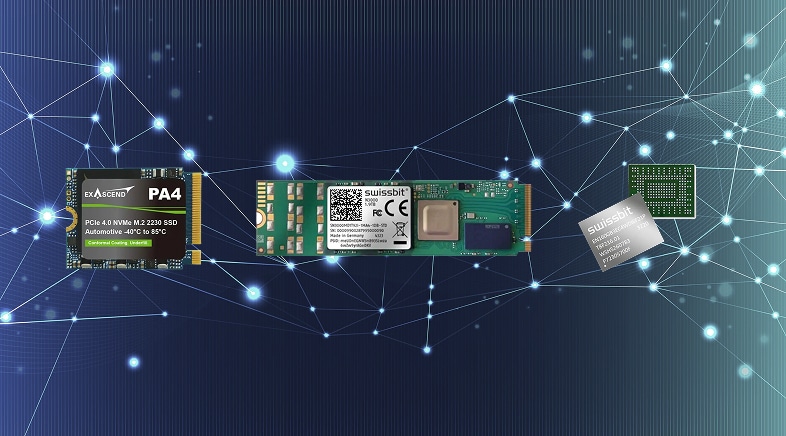
Because every embedded project comes with specific dimensional constraints, Mozaïk Storage offers this PCIe Gen4 technological platform in ruggedized, standardized, and ultra-compact form factors. System designers can seamlessly integrate these technologies based on their available space and data volume requirements, choosing from a catalog of over 30 configurable variants.
Physical Form Factors Available: M.2 2230, 2242, and M.2 2280
Standard N7000 Series: Built on high-density 3D TLC Flash chips, this variant is ideal for standard and read-intensive applications. Capacities range from 240 GB to 3.84 TB. These modules can be configured for two operating temperature ranges: commercial grade (C-grade), operational from 0°C to +70°C, and ruggedized industrial grade (I-grade), capable of withstanding environments from -40°C to +85°C for programmable logic controllers and outdoor robotics.
High-Endurance N7600 Series: Specifically designed for continuous data acquisition, intensive logging, and system caching workloads, this version relies on pSLC technology. This advanced operating mode simulates a single-level cell, multiplying the component’s write endurance by more than tenfold compared to standard Flash memory. Available storage volumes range from 80 GB to 1.28 TB, perfectly qualified to withstand the harshest industrial temperatures.
Planned Future Evolutions: Mozaïk Storage is preparing the arrival of the N7001 and N7601 technological variants by mid-year. These versions will integrate hardware-based write protection via a physical pin, secure Fast Erase capabilities, and conformal coating options to protect against moisture and dust in the most hostile environments.
Optimizing Your Supply Chain with Mozaïk Storage
Choosing components distributed by Mozaïk Storage means securing a stable supply chain based on technology where Flash chip packaging, the internal controller, and proprietary firmware development are entirely mastered and vertically managed. This eliminates the risk of sudden software incompatibilities and safeguards the long-term sustainability of your industrial production lines. Our technical team is entirely at your disposal to support you from the prototyping phase (with engineering samples available) up to mass deployment, configuring these modules precisely to match your power budgets and application workload profiles.
Frequently Asked Questions about Industrial PCIe Gen4 Storage
Why choose a DRAM-less SSD architecture for an embedded computer system?
The absence of a DRAM chip on an industrial SSD significantly reduces power consumption and heat generation inside the enclosure. Thanks to Host Memory Buffer (HMB) technology, the drive maintains excellent access speeds and optimal responsiveness for running industrial applications without requiring an extra RAM chip on the PCB.
What are the differences between the N7000 and N7600 storage series available at Mozaïk Storage?
The N7000 series uses high-density 3D TLC storage technology to offer high capacities up to 3.84 TB, making it perfect for general applications and Edge AI. The N7600 series utilizes a high-endurance pSLC operating mode that extends the drive’s useful write life by more than tenfold, making it ideal for continuous data logging, HD video surveillance, and network journaling.
What is the thermal resistance of the PCIe Gen4 SSDs offered for robotics?
For advanced robotics or automation environments, our industrial-grade (I-grade) drives are specifically tested and validated to operate stably across a temperature range spanning from -40°C to +85°C, preventing failures related to extreme cold or overheating in outdoor installations.
How does the NVMe Power-Loss Notification feature protect factory data?
This feature sends an immediate warning signal to the drive’s firmware as soon as a voltage drop occurs on the motherboard. This allows the SSD to quickly finalize the recording of vital metadata and secure data blocks currently in transit before the equipment completely shuts down, preventing any software corruption upon rebooting.
What hardware security options are available on these storage modules?
These components feature fully hardware-managed 256-bit AES data encryption, support for TCG Opal 2.0 security protocols, Crypto Erase encryption, and a Secure Boot feature to instantly neutralize data access or guarantee firmware integrity during system maintenance operations.